Classic
Ali Baba and the Forty Thieves
Andrew Lang
A poor woodcutter hides in a tree and hears forty robbers open their secret cave with the words "Open, Sesame!" He takes some of their gold, and soon the robbers' captain sets out to find the man who knows their secret.
about 3,600 words · 5–30 min to read.
Read it
You read English on the left. German is on the right to help you, and while reading, the eye button blurs or hides it.
Each paragraph followed by its German for your e-reader or tablet, or a side-by-side PDF to print. Which file do I need?
Downloads need a free account. No payment, nothing to install.
Already have an account? Log in
How it begins
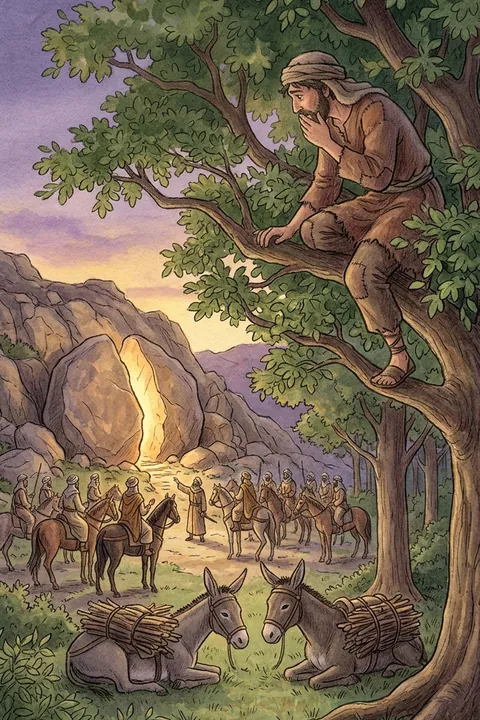
In a town in Persia there dwelt two brothers, one named Cassim, the other Ali Baba. Cassim was married to a rich wife and lived in plenty, while Ali Baba had to maintain his wife and children by cutting wood in a neighboring forest and selling it in the town. One day, when Ali Baba was in the forest, he saw a troop of men on horseback, coming toward him in a cloud of dust. He was afraid they were robbers, and climbed into a tree for safety. When they came up to him and dismounted, he counted forty of them. They unbridled their horses and tied them to trees. The finest man among them, whom Ali Baba took to be their captain, went a little way among some bushes, and said: “Open, Sesame!” so plainly that Ali Baba heard him. A door opened in the rocks, and having made the troop go in, he followed them, and the door shut again of itself. They stayed some time inside, and Ali Baba, fearing they might come out and catch him, was forced to sit patiently in the tree. At last the door opened again, and the Forty Thieves came out. As the Captain went in last he came out first, and made them all pass by him; he then closed the door, saying: “Shut, Sesame!” Every man bridled his horse and mounted, the Captain put himself at their head, and they returned as they came.
In einer Stadt in Persien lebten zwei Brüder, von denen der eine Cassim und der andere Ali Baba hieß. Cassim war mit einer reichen Frau verheiratet und lebte im Überfluss, während Ali Baba seine Frau und seine Kinder ernähren musste, indem er in einem nahe gelegenen Wald Holz schlug und es in der Stadt verkaufte. Eines Tages, als Ali Baba im Wald war, sah er eine Schar von Männern zu Pferd, die in einer Staubwolke auf ihn zukamen. Er fürchtete, sie seien Räuber, und kletterte zu seiner Sicherheit auf einen Baum. Als sie an ihn herankamen und abstiegen, zählte er ihrer vierzig. Sie zäumten ihre Pferde ab und banden sie an Bäume. Der vornehmste Mann unter ihnen, den Ali Baba für ihren Hauptmann hielt, ging ein kurzes Stück zwischen einige Büsche und sagte: „Sesam, öffne dich!“, und zwar so deutlich, dass Ali Baba ihn hörte. Eine Tür öffnete sich in den Felsen, und nachdem er die Schar hatte hineingehen lassen, folgte er ihnen, und die Tür schloss sich wieder von selbst. Sie blieben einige Zeit drinnen, und Ali Baba, der fürchtete, sie könnten herauskommen und ihn fassen, war gezwungen, geduldig auf dem Baum zu sitzen. Endlich öffnete sich die Tür wieder, und die vierzig Räuber traten heraus. Da der Hauptmann als Letzter hineingegangen war, kam er als Erster heraus und ließ sie alle an sich vorübergehen; dann schloss er die Tür, indem er sagte: „Sesam, schließe dich!“ Jeder Mann zäumte sein Pferd auf und stieg auf, der Hauptmann stellte sich an ihre Spitze, und sie kehrten auf demselben Wege zurück, wie sie gekommen waren.
Then Ali Baba climbed down and went to the door concealed among the bushes, and said: “Open, Sesame!” and it flew open. Ali Baba, who expected a dull, dismal place, was greatly surprised to find it large and well lighted, hollowed by the hand of man in the form of a vault, which received the light from an opening in the ceiling. He saw rich bales of merchandise--silk, stuff-brocades, all piled together, and gold and silver in heaps, and money in leather purses. He went in and the door shut behind him. He did not look at the silver, but brought out as many bags of gold as he thought his asses, which were browsing outside, could carry, loaded them with the bags, and hid it all with fagots. Using the words: “Shut, Sesame!” he closed the door and went home.
Darauf kletterte Ali Baba herab, ging zu der unter den Büschen verborgenen Tür und sagte: „Sesam, öffne dich!“, und sie flog auf. Ali Baba, der einen düsteren, trostlosen Ort erwartet hatte, war sehr erstaunt, ihn weit und wohl erhellt zu finden, von Menschenhand in Gestalt eines Gewölbes ausgehöhlt, welches das Licht durch eine Öffnung in der Decke empfing. Er sah reiche Ballen von Kaufmannsgütern – Seide, Stoffbrokate, alles aufeinandergehäuft, und Gold und Silber in Haufen und Geld in ledernen Beuteln. Er ging hinein, und die Tür schloss sich hinter ihm. Er sah das Silber gar nicht an, sondern brachte so viele Säcke mit Gold heraus, wie seine Esel, die draußen weideten, nach seiner Meinung tragen konnten, belud sie mit den Säcken und verbarg das Ganze unter Reisigbündeln. Mit den Worten: „Sesam, schließe dich!“ verschloss er die Tür und ging nach Hause.
Then he drove his asses into the yard, shut the gates, carried the money-bags to his wife, and emptied them out before her. He bade her keep the secret, and he would go and bury the gold. “Let me first measure it,” said his wife. “I will go borrow a measure of someone, while you dig the hole.” So she ran to the wife of Cassim and borrowed a measure. Knowing Ali Baba’s poverty, the sister was curious to find out what sort of grain his wife wished to measure, and artfully put some suet at the bottom of the measure. Ali Baba’s wife went home and set the measure on the heap of gold, and filled it and emptied it often, to her great content. She then carried it back to her sister, without noticing that a piece of gold was sticking to it, which Cassim’s wife perceived directly her back was turned. She grew very curious, and said to Cassim when he came home: “Cassim, your brother is richer than you. He does not count his money, he measures it.” He begged her to explain this riddle, which she did by showing him the piece of money and telling him where she found it. Then Cassim grew so envious that he could not sleep, and went to his brother in the morning before sunrise. “Ali Baba,” he said, showing him the gold piece, “you pretend to be poor and yet you measure gold.” By this Ali Baba perceived that through his wife’s folly Cassim and his wife knew their secret, so he confessed all and offered Cassim a share. “That I expect,” said Cassim; “but I must know where to find the treasure, otherwise I will discover all, and you will lose all.” Ali Baba, more out of kindness than fear, told him of the cave, and the very words to use. Cassim left Ali Baba, meaning to be beforehand with him and get the treasure for himself. He rose early next morning, and set out with ten mules loaded with great chests. He soon found the place, and the door in the rock. He said: “Open, Sesame!” and the door opened and shut behind him. He could have feasted his eyes all day on the treasures, but he now hastened to gather together as much of it as possible; but when he was ready to go he could not remember what to say for thinking of his great riches. Instead of “Sesame,” he said: “Open, Barley!” and the door remained fast. He named several different sorts of grain, all but the right one, and the door still stuck fast. He was so frightened at the danger he was in that he had as much forgotten the word as if he had never heard it.
Dann trieb er seine Esel in den Hof, schloss die Tore, trug die Geldbeutel zu seiner Frau und schüttete sie vor ihr aus. Er hieß sie, das Geheimnis zu wahren, und er wolle gehen und das Gold vergraben. „Lass es mich zuerst messen“, sagte seine Frau. „Ich will gehen und mir von jemandem ein Maß leihen, während du das Loch gräbst.“ So lief sie zur Frau von Cassim und lieh sich ein Maß. Da sie Ali Babas Armut kannte, war die Schwägerin neugierig zu erfahren, was für eine Art von Getreide seine Frau wohl messen wollte, und strich listig etwas Talg auf den Boden des Maßes. Ali Babas Frau ging nach Hause, setzte das Maß auf den Goldhaufen und füllte und leerte es oftmals, zu ihrer großen Zufriedenheit. Dann trug sie es zu ihrer Schwägerin zurück, ohne zu bemerken, dass ein Goldstück daran kleben geblieben war, was Cassims Frau sogleich gewahrte, als jene ihr den Rücken kehrte. Sie wurde sehr neugierig und sagte zu Cassim, als er nach Hause kam: „Cassim, dein Bruder ist reicher als du. Er zählt sein Geld nicht, er misst es.“ Er bat sie, dieses Rätsel zu erklären, was sie tat, indem sie ihm das Geldstück zeigte und ihm erzählte, wo sie es gefunden hatte. Da wurde Cassim so neidisch, dass er nicht schlafen konnte, und ging am Morgen vor Sonnenaufgang zu seinem Bruder. „Ali Baba“, sagte er und zeigte ihm das Goldstück, „du stellst dich arm und misst doch Gold.“ Daran erkannte Ali Baba, dass durch die Torheit seiner Frau Cassim und dessen Frau ihr Geheimnis kannten; so gestand er alles und bot Cassim einen Anteil an. „Das erwarte ich auch“, sagte Cassim; „aber ich muss wissen, wo der Schatz zu finden ist, sonst werde ich alles aufdecken, und du wirst alles verlieren.“ Ali Baba, mehr aus Güte als aus Furcht, erzählte ihm von der Höhle und den genauen Worten, die man gebrauchen müsse. Cassim verließ Ali Baba in der Absicht, ihm zuvorzukommen und den Schatz für sich allein zu holen. Er stand am nächsten Morgen früh auf und brach mit zehn Maultieren auf, die mit großen Kisten beladen waren. Er fand den Ort und die Tür im Felsen bald. Er sagte: „Sesam, öffne dich!“, und die Tür öffnete sich und schloss sich hinter ihm. Er hätte seine Augen den ganzen Tag an den Schätzen weiden können, doch nun beeilte er sich, so viel wie möglich davon zusammenzuraffen; aber als er bereit war zu gehen, konnte er sich vor lauter Gedanken an seine großen Reichtümer nicht mehr erinnern, was er sagen sollte. Statt „Sesam“ sagte er: „Gerste, öffne dich!“, und die Tür blieb fest verschlossen. Er nannte mehrere verschiedene Getreidearten, alle außer der richtigen, und die Tür blieb noch immer fest verschlossen. Er erschrak so sehr über die Gefahr, in der er schwebte, dass er das Wort ebenso vergessen hatte, als hätte er es nie gehört.
Languages
All 17 editions: titles, levels and lengths
- Ali Baba and the Forty Thieves · English (original)B2 Intermediate · 3,582 words · ~25 min
- Ali Baba und die vierzig Räuber · GermanB2 Intermediate · 3,688 words · ~25 min
- Ο Αλή Μπαμπάς και οι σαράντα κλέφτες · GreekB2 Intermediate · 3,616 words · ~25 min
- Alí Babá y los cuarenta ladrones · SpanishB2 Intermediate · 3,602 words · ~25 min
- Ali Baba et les Quarante Voleurs · FrenchB2 Intermediate · 4,068 words · ~25 min
- अली बाबा और चालीस चोर · HindiB2 Intermediate · 4,144 words · ~30 min
- Ali Baba dan Empat Puluh Penyamun · IndonesianB2 Intermediate · 3,287 words · ~20 min
- Alì Babà e i quaranta ladroni · ItalianB2 Intermediate · 3,502 words · ~25 min
- アリババと四十人の盗賊 · JapaneseB2 Intermediate
- 알리바바와 40인의 도둑 · KoreanB2 Intermediate · 2,512 words · ~15 min
- Ali Baba en de veertig rovers · DutchB2 Intermediate · 3,809 words · ~25 min
- Ali Baba i czterdziestu rozbójników · PolishB2 Intermediate · 2,999 words · ~20 min
- Ali Babá e os Quarenta Ladrões · PortugueseB2 Intermediate · 3,551 words · ~25 min
- Ali Baba și cei patruzeci de hoți · RomanianB2 Intermediate · 3,506 words · ~25 min
- Ali Baba ve Kırk Haramiler · TurkishB2 Intermediate · 2,560 words · ~15 min
- Ali Baba và bốn mươi tên cướp · VietnameseB2 Intermediate · 4,382 words · ~30 min
- 阿里巴巴和四十大盗 · ChineseB2 Intermediate
Open it in the reader: all 272 language pairs
German with English · Greek with English · Spanish with English · French with English · Hindi with English · Indonesian with English · Italian with English · Japanese with English · Korean with English · Dutch with English · Polish with English · Portuguese with English · Romanian with English · Turkish with English · Vietnamese with English · Chinese with English · English with German · English with Greek · English with Spanish · English with French · English with Hindi · English with Indonesian · English with Italian · English with Japanese · English with Korean · English with Dutch · English with Polish · English with Portuguese · English with Romanian · English with Turkish · English with Vietnamese · English with Chinese · German with Greek · German with Spanish · German with French · German with Hindi · German with Indonesian · German with Italian · German with Japanese · German with Korean · German with Dutch · German with Polish · German with Portuguese · German with Romanian · German with Turkish · German with Vietnamese · German with Chinese · Greek with German · Greek with Spanish · Greek with French · Greek with Hindi · Greek with Indonesian · Greek with Italian · Greek with Japanese · Greek with Korean · Greek with Dutch · Greek with Polish · Greek with Portuguese · Greek with Romanian · Greek with Turkish · Greek with Vietnamese · Greek with Chinese · Spanish with German · Spanish with Greek · Spanish with French · Spanish with Hindi · Spanish with Indonesian · Spanish with Italian · Spanish with Japanese · Spanish with Korean · Spanish with Dutch · Spanish with Polish · Spanish with Portuguese · Spanish with Romanian · Spanish with Turkish · Spanish with Vietnamese · Spanish with Chinese · French with German · French with Greek · French with Spanish · French with Hindi · French with Indonesian · French with Italian · French with Japanese · French with Korean · French with Dutch · French with Polish · French with Portuguese · French with Romanian · French with Turkish · French with Vietnamese · French with Chinese · Hindi with German · Hindi with Greek · Hindi with Spanish · Hindi with French · Hindi with Indonesian · Hindi with Italian · Hindi with Japanese · Hindi with Korean · Hindi with Dutch · Hindi with Polish · Hindi with Portuguese · Hindi with Romanian · Hindi with Turkish · Hindi with Vietnamese · Hindi with Chinese · Indonesian with German · Indonesian with Greek · Indonesian with Spanish · Indonesian with French · Indonesian with Hindi · Indonesian with Italian · Indonesian with Japanese · Indonesian with Korean · Indonesian with Dutch · Indonesian with Polish · Indonesian with Portuguese · Indonesian with Romanian · Indonesian with Turkish · Indonesian with Vietnamese · Indonesian with Chinese · Italian with German · Italian with Greek · Italian with Spanish · Italian with French · Italian with Hindi · Italian with Indonesian · Italian with Japanese · Italian with Korean · Italian with Dutch · Italian with Polish · Italian with Portuguese · Italian with Romanian · Italian with Turkish · Italian with Vietnamese · Italian with Chinese · Japanese with German · Japanese with Greek · Japanese with Spanish · Japanese with French · Japanese with Hindi · Japanese with Indonesian · Japanese with Italian · Japanese with Korean · Japanese with Dutch · Japanese with Polish · Japanese with Portuguese · Japanese with Romanian · Japanese with Turkish · Japanese with Vietnamese · Japanese with Chinese · Korean with German · Korean with Greek · Korean with Spanish · Korean with French · Korean with Hindi · Korean with Indonesian · Korean with Italian · Korean with Japanese · Korean with Dutch · Korean with Polish · Korean with Portuguese · Korean with Romanian · Korean with Turkish · Korean with Vietnamese · Korean with Chinese · Dutch with German · Dutch with Greek · Dutch with Spanish · Dutch with French · Dutch with Hindi · Dutch with Indonesian · Dutch with Italian · Dutch with Japanese · Dutch with Korean · Dutch with Polish · Dutch with Portuguese · Dutch with Romanian · Dutch with Turkish · Dutch with Vietnamese · Dutch with Chinese · Polish with German · Polish with Greek · Polish with Spanish · Polish with French · Polish with Hindi · Polish with Indonesian · Polish with Italian · Polish with Japanese · Polish with Korean · Polish with Dutch · Polish with Portuguese · Polish with Romanian · Polish with Turkish · Polish with Vietnamese · Polish with Chinese · Portuguese with German · Portuguese with Greek · Portuguese with Spanish · Portuguese with French · Portuguese with Hindi · Portuguese with Indonesian · Portuguese with Italian · Portuguese with Japanese · Portuguese with Korean · Portuguese with Dutch · Portuguese with Polish · Portuguese with Romanian · Portuguese with Turkish · Portuguese with Vietnamese · Portuguese with Chinese · Romanian with German · Romanian with Greek · Romanian with Spanish · Romanian with French · Romanian with Hindi · Romanian with Indonesian · Romanian with Italian · Romanian with Japanese · Romanian with Korean · Romanian with Dutch · Romanian with Polish · Romanian with Portuguese · Romanian with Turkish · Romanian with Vietnamese · Romanian with Chinese · Turkish with German · Turkish with Greek · Turkish with Spanish · Turkish with French · Turkish with Hindi · Turkish with Indonesian · Turkish with Italian · Turkish with Japanese · Turkish with Korean · Turkish with Dutch · Turkish with Polish · Turkish with Portuguese · Turkish with Romanian · Turkish with Vietnamese · Turkish with Chinese · Vietnamese with German · Vietnamese with Greek · Vietnamese with Spanish · Vietnamese with French · Vietnamese with Hindi · Vietnamese with Indonesian · Vietnamese with Italian · Vietnamese with Japanese · Vietnamese with Korean · Vietnamese with Dutch · Vietnamese with Polish · Vietnamese with Portuguese · Vietnamese with Romanian · Vietnamese with Turkish · Vietnamese with Chinese · Chinese with German · Chinese with Greek · Chinese with Spanish · Chinese with French · Chinese with Hindi · Chinese with Indonesian · Chinese with Italian · Chinese with Japanese · Chinese with Korean · Chinese with Dutch · Chinese with Polish · Chinese with Portuguese · Chinese with Romanian · Chinese with Turkish · Chinese with Vietnamese
More stories at this level
Intermediate stories in English with German beside it.
- The Remarkable RocketOscar Wilde · B2 · 4,373 words
- Cinderella, or the Little Glass SlipperCharles Perrault · B2 · 2,458 words
- Aladdin and the Wonderful LampAndrew Lang · B2 · 5,295 words
- Puss in BootsCharles Perrault · B2 · 1,838 words
- Little Red Riding HoodCharles Perrault · B2 · 838 words
- Sindbad the SailorAndrew Lang · B2 · 16,169 words
Reading it as a parallel text
A parallel text puts a story next to its translation, paragraph by paragraph. Read in the language you are working on and glance across only when a sentence stops you: the story keeps moving, and the words you look up stay in context. More in how to read with a parallel text.
Questions
Which languages can I read Ali Baba and the Forty Thieves in?
English, German, Greek, Spanish, French, Hindi, Indonesian, Italian, Japanese, Korean, Dutch, Polish, Portuguese, Romanian, Turkish, Vietnamese and Chinese. Pick the language you want to read and the one to keep beside it: every paragraph sits next to its translation, so you can check a sentence without losing your place.
What level is it?
The original English is B2 Intermediate. In translation, German, Greek, Spanish, French, Hindi, Indonesian, Italian, Japanese, Korean, Dutch, Polish, Portuguese, Romanian, Turkish, Vietnamese and Chinese are B2 Intermediate. Levels follow the Common European Framework, from A1 (beginner) to C2.
How long is it?
About 3,582 words: around 5–30 min of reading, with the translation beside it. The time depends on the edition's level: an easier edition is read more slowly.
Is it free?
Yes. Read it online with no account. The downloads (PDF, EPUB, and AZW3 and MOBI for Kindle) need a free account.
Can I read it on a Kindle or Kobo?
Yes. Download the EPUB for Kobo, Apple Books and most e-readers, or the AZW3 or MOBI for a Kindle, with each paragraph followed by its translation. There is also a side-by-side PDF to print, and each language on its own.