Original story
Die Bremse von San Rafael
DuoText original
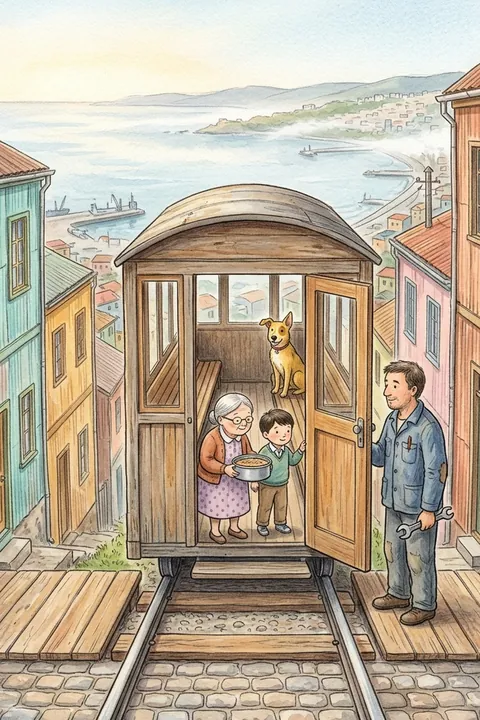
For six years Don Rodrigo's letter of resignation has been lying in the drawer of the top station, and for six years the city has found no one to replace him. When an inspector arrives to shut down the old funicular of Valparaíso, he seems to have reached his goal at last. Then the neighbourhood hears about it.
4 chapters · about 2,600 words · 5–25 min to read.
Read it
You read German on the left. English is on the right to help you, and while reading, the eye button blurs or hides it.
Free account, no payment, no card. Then download this book for your Kindle, Kobo or as a PDF.
EPUB · PDF · Kindle (AZW3, MOBI) · Kobo
Already have an account? Log in
How it begins
Der Brief in der Schublade
The Letter in the Drawer
Die Standseilbahn von San Rafael war einhundertzwölf Jahre alt, einunddreißig Meter hoch und die kürzeste Verbindung zwischen dem Hafen von Valparaíso und dem Viertel auf dem Hügel. Zwei Holzkabinen hingen an einem einzigen Seil, die eine fuhr hinauf, während die andere hinunterglitt, und in der Mitte der Strecke, an der Ausweichstelle, grüßten sie einander mit einem Quietschen, das jedes Kind im Viertel nachmachen konnte.
The funicular of San Rafael was a hundred and twelve years old, thirty-one metres high, and the shortest link between the harbour of Valparaíso and the neighbourhood on the hill. Two wooden cabins hung from a single cable; one went up while the other slid down, and halfway along the track, at the passing place, they greeted each other with a squeak that every child in the neighbourhood could imitate.
Gebaut hatte sie ein Schweizer Ingenieur, der nie in Chile gewesen war und seine Pläne auf Papier geschickt hatte, mit dem Hinweis, Valparaíso sei „eine Stadt für Ziegen und Optimisten“. Seither hatte die Bahn zwei Erdbeben überstanden, einen Brand und, wie die Leute im Viertel sagten, sieben Bürgermeister, was weit schwieriger gewesen sei.
It had been built by a Swiss engineer who had never been to Chile and had sent his plans on paper with the remark that Valparaíso was “a city for goats and optimists”. Since then the railway had survived two earthquakes, a fire and, as people in the neighbourhood said, seven mayors, which had been far more difficult.
Languages
All 17 editions: titles, levels and lengths
- Die Bremse von San Rafael · German (original)B2 Intermediate · 2,555 words · ~15 min
- Το φρένο του San Rafael · GreekB2 Intermediate · 2,738 words · ~20 min
- The Brake at San Rafael · EnglishB2 Intermediate · 2,758 words · ~20 min
- El freno de San Rafael · SpanishB2 Intermediate · 2,831 words · ~20 min
- Le frein de San Rafael · FrenchB2 Intermediate · 3,117 words · ~20 min
- सैन राफ़ेल का ब्रेक · HindiB2 Intermediate · 3,185 words · ~20 min
- Rem San Rafael · IndonesianB2 Intermediate · 2,576 words · ~15 min
- Il freno di San Rafael · ItalianB2 Intermediate · 2,646 words · ~20 min
- サン・ラファエルのブレーキ · JapaneseB2 Intermediate
- 산 라파엘의 브레이크 · KoreanB2 Intermediate · 2,029 words · ~15 min
- De rem van San Rafael · DutchB2 Intermediate · 2,713 words · ~20 min
- Hamulec ze stacji San Rafael · PolishB2 Intermediate · 2,262 words · ~15 min
- O Freio de San Rafael · PortugueseB2 Intermediate · 2,727 words · ~20 min
- Frâna de la San Rafael · RomanianB2 Intermediate · 2,741 words · ~20 min
- San Rafael’in Freni · TurkishB2 Intermediate · 2,027 words · ~15 min
- Chiếc phanh của San Rafael · VietnameseB2 Intermediate · 3,547 words · ~25 min
- 圣拉斐尔的制动器 · ChineseB2 Intermediate
Open it in the reader: all 272 language pairs
German with English · Greek with English · English with German · Spanish with English · French with English · Hindi with English · Indonesian with English · Italian with English · Japanese with English · Korean with English · Dutch with English · Polish with English · Portuguese with English · Romanian with English · Turkish with English · Vietnamese with English · Chinese with English · German with Greek · German with Spanish · German with French · German with Hindi · German with Indonesian · German with Italian · German with Japanese · German with Korean · German with Dutch · German with Polish · German with Portuguese · German with Romanian · German with Turkish · German with Vietnamese · German with Chinese · Greek with German · Greek with Spanish · Greek with French · Greek with Hindi · Greek with Indonesian · Greek with Italian · Greek with Japanese · Greek with Korean · Greek with Dutch · Greek with Polish · Greek with Portuguese · Greek with Romanian · Greek with Turkish · Greek with Vietnamese · Greek with Chinese · English with Greek · English with Spanish · English with French · English with Hindi · English with Indonesian · English with Italian · English with Japanese · English with Korean · English with Dutch · English with Polish · English with Portuguese · English with Romanian · English with Turkish · English with Vietnamese · English with Chinese · Spanish with German · Spanish with Greek · Spanish with French · Spanish with Hindi · Spanish with Indonesian · Spanish with Italian · Spanish with Japanese · Spanish with Korean · Spanish with Dutch · Spanish with Polish · Spanish with Portuguese · Spanish with Romanian · Spanish with Turkish · Spanish with Vietnamese · Spanish with Chinese · French with German · French with Greek · French with Spanish · French with Hindi · French with Indonesian · French with Italian · French with Japanese · French with Korean · French with Dutch · French with Polish · French with Portuguese · French with Romanian · French with Turkish · French with Vietnamese · French with Chinese · Hindi with German · Hindi with Greek · Hindi with Spanish · Hindi with French · Hindi with Indonesian · Hindi with Italian · Hindi with Japanese · Hindi with Korean · Hindi with Dutch · Hindi with Polish · Hindi with Portuguese · Hindi with Romanian · Hindi with Turkish · Hindi with Vietnamese · Hindi with Chinese · Indonesian with German · Indonesian with Greek · Indonesian with Spanish · Indonesian with French · Indonesian with Hindi · Indonesian with Italian · Indonesian with Japanese · Indonesian with Korean · Indonesian with Dutch · Indonesian with Polish · Indonesian with Portuguese · Indonesian with Romanian · Indonesian with Turkish · Indonesian with Vietnamese · Indonesian with Chinese · Italian with German · Italian with Greek · Italian with Spanish · Italian with French · Italian with Hindi · Italian with Indonesian · Italian with Japanese · Italian with Korean · Italian with Dutch · Italian with Polish · Italian with Portuguese · Italian with Romanian · Italian with Turkish · Italian with Vietnamese · Italian with Chinese · Japanese with German · Japanese with Greek · Japanese with Spanish · Japanese with French · Japanese with Hindi · Japanese with Indonesian · Japanese with Italian · Japanese with Korean · Japanese with Dutch · Japanese with Polish · Japanese with Portuguese · Japanese with Romanian · Japanese with Turkish · Japanese with Vietnamese · Japanese with Chinese · Korean with German · Korean with Greek · Korean with Spanish · Korean with French · Korean with Hindi · Korean with Indonesian · Korean with Italian · Korean with Japanese · Korean with Dutch · Korean with Polish · Korean with Portuguese · Korean with Romanian · Korean with Turkish · Korean with Vietnamese · Korean with Chinese · Dutch with German · Dutch with Greek · Dutch with Spanish · Dutch with French · Dutch with Hindi · Dutch with Indonesian · Dutch with Italian · Dutch with Japanese · Dutch with Korean · Dutch with Polish · Dutch with Portuguese · Dutch with Romanian · Dutch with Turkish · Dutch with Vietnamese · Dutch with Chinese · Polish with German · Polish with Greek · Polish with Spanish · Polish with French · Polish with Hindi · Polish with Indonesian · Polish with Italian · Polish with Japanese · Polish with Korean · Polish with Dutch · Polish with Portuguese · Polish with Romanian · Polish with Turkish · Polish with Vietnamese · Polish with Chinese · Portuguese with German · Portuguese with Greek · Portuguese with Spanish · Portuguese with French · Portuguese with Hindi · Portuguese with Indonesian · Portuguese with Italian · Portuguese with Japanese · Portuguese with Korean · Portuguese with Dutch · Portuguese with Polish · Portuguese with Romanian · Portuguese with Turkish · Portuguese with Vietnamese · Portuguese with Chinese · Romanian with German · Romanian with Greek · Romanian with Spanish · Romanian with French · Romanian with Hindi · Romanian with Indonesian · Romanian with Italian · Romanian with Japanese · Romanian with Korean · Romanian with Dutch · Romanian with Polish · Romanian with Portuguese · Romanian with Turkish · Romanian with Vietnamese · Romanian with Chinese · Turkish with German · Turkish with Greek · Turkish with Spanish · Turkish with French · Turkish with Hindi · Turkish with Indonesian · Turkish with Italian · Turkish with Japanese · Turkish with Korean · Turkish with Dutch · Turkish with Polish · Turkish with Portuguese · Turkish with Romanian · Turkish with Vietnamese · Turkish with Chinese · Vietnamese with German · Vietnamese with Greek · Vietnamese with Spanish · Vietnamese with French · Vietnamese with Hindi · Vietnamese with Indonesian · Vietnamese with Italian · Vietnamese with Japanese · Vietnamese with Korean · Vietnamese with Dutch · Vietnamese with Polish · Vietnamese with Portuguese · Vietnamese with Romanian · Vietnamese with Turkish · Vietnamese with Chinese · Chinese with German · Chinese with Greek · Chinese with Spanish · Chinese with French · Chinese with Hindi · Chinese with Indonesian · Chinese with Italian · Chinese with Japanese · Chinese with Korean · Chinese with Dutch · Chinese with Polish · Chinese with Portuguese · Chinese with Romanian · Chinese with Turkish · Chinese with Vietnamese
More stories at this level
Intermediate stories in German with English beside it (all of them: Intermediate German stories).
- Dienstags um zehnDuoText · B2 · 2,650 words
- Der Drache vom PilatusDuoText · B2 · 6,250 words
- Das Siegel von ZürichDuoText · B2 · 6,461 words
- Das Versprechen am RheinfallDuoText · B2 · 6,546 words
- Die letzte Fahrt der GalliaDuoText · B2 · 6,592 words
- Der Wächter im Gonzen-StollenDuoText · B2 · 7,119 words
Reading it as a parallel text
A parallel text puts a story next to its translation, paragraph by paragraph. Read in the language you are working on and glance across only when a sentence stops you: the story keeps moving, and the words you look up stay in context. More in how to read with a parallel text.
Questions
Which languages can I read Die Bremse von San Rafael in?
German, Greek, English, Spanish, French, Hindi, Indonesian, Italian, Japanese, Korean, Dutch, Polish, Portuguese, Romanian, Turkish, Vietnamese and Chinese. Pick the language you want to read and the one to keep beside it: every paragraph sits next to its translation, so you can check a sentence without losing your place.
What level is it?
The original German is B2 Intermediate. In translation, Greek, English, Spanish, French, Hindi, Indonesian, Italian, Japanese, Korean, Dutch, Polish, Portuguese, Romanian, Turkish, Vietnamese and Chinese are B2 Intermediate. Levels follow the Common European Framework, from A1 (beginner) to C2.
How long is it?
About 2,555 words in 4 chapters: around 5–25 min of reading, with the translation beside it. The time depends on the edition's level: an easier edition is read more slowly.
Is it free?
Yes. Read it online with no account. The downloads (PDF, EPUB, and AZW3 and MOBI for Kindle) need a free account.
Can I read it on a Kindle or Kobo?
Yes. Download the EPUB for Kobo, Apple Books and most e-readers, or the AZW3 or MOBI for a Kindle, with each paragraph followed by its translation. There is also a side-by-side PDF to print, and each language on its own.