Classic
Die Geschichte von Wilhelm Tell
James Baldwin (1841–1925)
In each language: The Story of William Tell · Die Geschichte von Wilhelm Tell · La historia de Guillermo Tell · L’histoire de Guillaume Tell · La storia di Guglielmo Tell
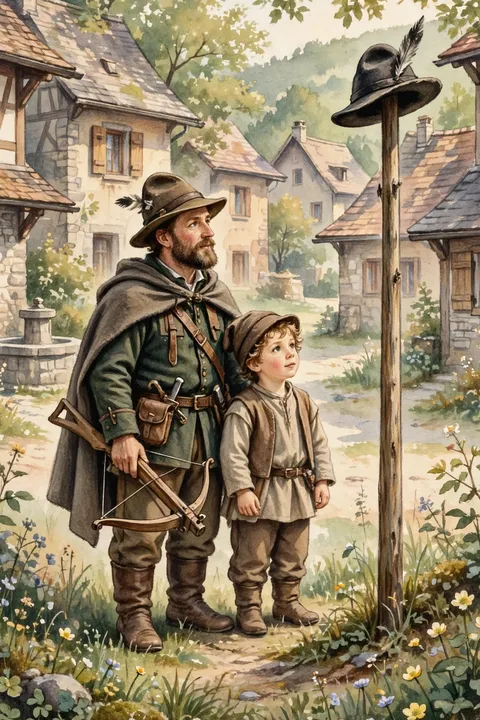
Long ago in Switzerland, the proud tyrant Gessler sets his cap on a pole and orders everyone to bow to it. Only William Tell, a famous hunter of the mountains, refuses. As punishment, he is commanded to shoot an apple from his own little boy's head with a single arrow.
In English, German, Spanish, French and Italian · about 450 words · 5 min to read.
Read it
You read German on the left. English is on the right to help you, and while reading, the eye button blurs or hides it.
Each paragraph followed by its English for your e-reader or tablet, or a side-by-side PDF to print. Which file do I need?
The PDF needs no account; e-reader files need a free one. No payment, nothing to install.
Already have an account? Log in
How it begins
Die Menschen in der Schweiz waren nicht immer so frei und glücklich wie heute. Vor vielen Jahren herrschte ein stolzer Tyrann namens Gessler über sie und machte ihr Los wahrlich bitter.
The people of Switzerland were not always free and happy as they are to-day. Many years ago a proud tyrant, whose name was Gessler, ruled over them, and made their lot a bitter one indeed.
Eines Tages stellte dieser Tyrann eine hohe Stange auf dem öffentlichen Platz auf und setzte seine eigene Mütze darauf; dann befahl er, dass jeder Mann, der in die Stadt kam, sich davor verneigen sollte.
One day this tyrant set up a tall pole in the public square, and put his own cap on the top of it; and then he gave orders that every man who came into the town should bow down before it.
Doch es gab einen Mann namens Wilhelm Tell, der dies nicht tun wollte. Er stand aufrecht mit verschränkten Armen da und lachte über die schwingende Mütze. Er wollte sich nicht einmal vor Gessler selbst verneigen.
But there was one man, named William Tell, who would not do this. He stood up straight with folded arms, and laughed at the swinging cap. He would not bow down to Gessler himself.
Languages
- The Story of William Tell · English (original)447 words · ~5 min
- Die Geschichte von Wilhelm Tell · GermanB1 Intermediate · 422 words · ~5 min
- La historia de Guillermo Tell · SpanishB1 Intermediate · 433 words · ~5 min
- L’histoire de Guillaume Tell · FrenchB1 Intermediate · 436 words · ~5 min
- La storia di Guglielmo Tell · ItalianB1 Intermediate · 421 words · ~5 min
Open in the reader: German with English · Spanish with English · French with English · Italian with English
More stories at this level
Intermediate stories in German with English beside it (all of them: Intermediate German stories).
- König Knut am MeeresstrandJames Baldwin (1841–1925) · B1 · 415 words
- Die blinden Männer und der ElefantJames Baldwin (1841–1925) · B1 · 409 words
- Alexander und BukephalosJames Baldwin (1841–1925) · B1 · 389 words
- Damon und PythiasJames Baldwin (1841–1925) · B1 · 461 words
- Die tapferen DreihundertJames Baldwin (1841–1925) · B1 · 380 words
- Das DamoklesschwertJames Baldwin (1841–1925) · B1 · 468 words
Reading it as a parallel text
A parallel text puts a story next to its translation, paragraph by paragraph. Read in the language you are working on and glance across only when a sentence stops you: the story keeps moving, and the words you look up stay in context. More in how to read with a parallel text.
Questions
- Which languages can I read The Story of William Tell in?
- English, German, Spanish, French and Italian. Pick the language you want to read and the one to keep beside it: every paragraph sits next to its translation, so you can check a sentence without losing your place.
- What level is it?
- In translation, German, Spanish, French and Italian are B1 Intermediate. Levels follow the Common European Framework, from A1 (beginner) to C2.
- How long is it?
- About 447 words: around 5 min of reading, with the translation beside it. The time depends on the edition's level: an easier edition is read more slowly.
- Is it free?
- Yes. Read it online with no account. The e-reader files (EPUB, and AZW3 and MOBI for Kindle) need a free account; the PDF doesn't.
- Can I read it on a Kindle or Kobo?
- Yes. Download the EPUB for Kobo, Apple Books and most e-readers, or the AZW3 or MOBI for a Kindle, with each paragraph followed by its translation. There is also a side-by-side PDF to print, and each language on its own.