Classic
Bruce und die Spinne
James Baldwin (1841–1925)
In each language: Bruce and the Spider · Bruce und die Spinne · Bruce y la araña · Robert Bruce et l’araignée · Bruce e il ragno
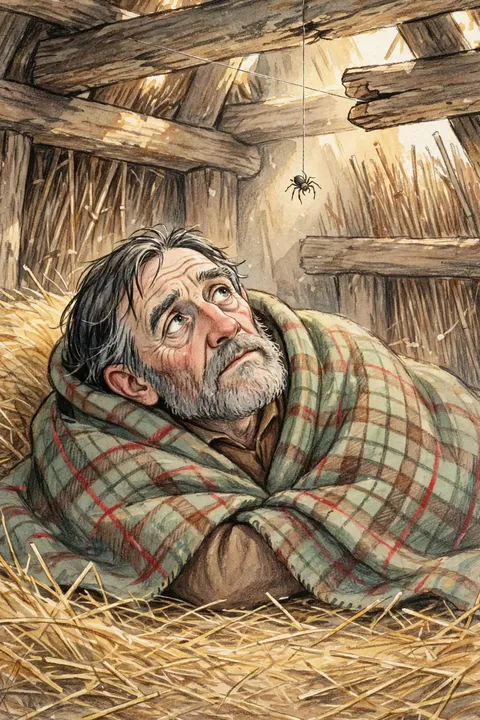
Robert Bruce, King of Scotland, hides exhausted in the wilderness after his army is beaten six times in a row. Lying under a rough shed, ready to give up, he notices a small spider trying over and over to finish her web.
In English, German, Spanish, French and Italian · about 400 words · 5 min to read.
Read it
You read German on the left. English is on the right to help you, and while reading, the eye button blurs or hides it.
Each paragraph followed by its English for your e-reader or tablet, or a side-by-side PDF to print. Which file do I need?
The PDF needs no account; e-reader files need a free one. No payment, nothing to install.
Already have an account? Log in
How it begins
Es war einmal ein König von Schottland namens Robert Bruce. Er musste sowohl tapfer als auch weise sein, denn die Zeiten, in denen er lebte, waren wild und rau.
There was once a king of Scotland whose name was Robert Bruce. He had need to be both brave and wise, for the times in which he lived were wild and rude.
Der König von England führte Krieg gegen ihn und hatte ein großes Heer nach Schottland geführt, um ihn aus dem Land zu vertreiben.
The King of England was at war with him, and had led a great army into Scotland to drive him out of the land.
Eine Schlacht nach der anderen war geschlagen worden. Sechsmal hatte Bruce sein tapferes kleines Heer gegen seine Feinde geführt; und sechsmal waren seine Männer geschlagen und in die Flucht geschlagen worden.
Battle after battle had been fought. Six times had Bruce led his brave little army against his foes; and six times had his men been beaten, and driven into flight.
Languages
- Bruce and the Spider · English (original)381 words · ~5 min
- Bruce und die Spinne · GermanB1 Intermediate · 371 words · ~5 min
- Bruce y la araña · SpanishB1 Intermediate · 350 words · ~5 min
- Robert Bruce et l’araignée · FrenchB1 Intermediate · 390 words · ~5 min
- Bruce e il ragno · ItalianB1 Intermediate · 352 words · ~5 min
Open in the reader: German with English · Spanish with English · French with English · Italian with English
More stories at this level
Intermediate stories in German with English beside it (all of them: Intermediate German stories).
- Die tapferen DreihundertJames Baldwin (1841–1925) · B1 · 380 words
- Die Prinzessin auf der ErbseHans Christian Andersen · B1 · 355 words
- Alexander und BukephalosJames Baldwin (1841–1925) · B1 · 389 words
- Die drei Männer von GothamJames Baldwin (1841–1925) · B1 · 353 words
- Diogenes der WeiseJames Baldwin (1841–1925) · B1 · 337 words
- Die blinden Männer und der ElefantJames Baldwin (1841–1925) · B1 · 409 words
Reading it as a parallel text
A parallel text puts a story next to its translation, paragraph by paragraph. Read in the language you are working on and glance across only when a sentence stops you: the story keeps moving, and the words you look up stay in context. More in how to read with a parallel text.
Questions
- Which languages can I read Bruce and the Spider in?
- English, German, Spanish, French and Italian. Pick the language you want to read and the one to keep beside it: every paragraph sits next to its translation, so you can check a sentence without losing your place.
- What level is it?
- In translation, German, Spanish, French and Italian are B1 Intermediate. Levels follow the Common European Framework, from A1 (beginner) to C2.
- How long is it?
- About 381 words: around 5 min of reading, with the translation beside it. The time depends on the edition's level: an easier edition is read more slowly.
- Is it free?
- Yes. Read it online with no account. The e-reader files (EPUB, and AZW3 and MOBI for Kindle) need a free account; the PDF doesn't.
- Can I read it on a Kindle or Kobo?
- Yes. Download the EPUB for Kobo, Apple Books and most e-readers, or the AZW3 or MOBI for a Kindle, with each paragraph followed by its translation. There is also a side-by-side PDF to print, and each language on its own.