Classic
Wie das Kamel zu seinem Höcker kam
Rudyard Kipling
In each language: How the Camel Got His Hump · Wie das Kamel zu seinem Höcker kam · Cómo le salió la joroba al Camello · Comment le Chameau eut sa bosse · Come il Cammello si fece la gobba
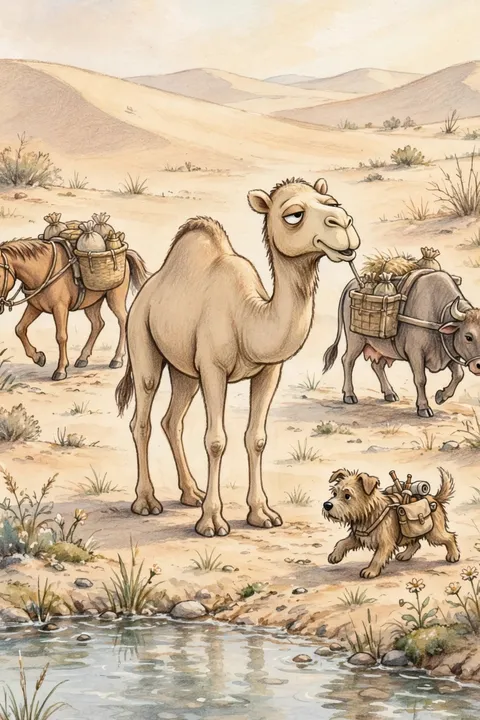
When the world is new and the Animals are just beginning to work for Man, an idle Camel stays in the middle of a Howling Desert and answers every request with ‘Humph!’ The Horse, Dog, and Ox must work double-time, grow angry, and appeal to the Djinn in charge of All Deserts.
In English, German, Spanish, French and Italian · about 1,100 words · 5–10 min to read.
Read it
Du liest links auf Deutsch. Englisch steht rechts als Hilfe, und beim Lesen kannst du es mit der Augen-Taste verwischen oder ausblenden.
Jeder Absatz mit anschließender Englisch-Fassung für deinen E-Reader oder dein Tablet, oder ein PDF mit beiden Sprachen nebeneinander zum Drucken. Welche Datei brauche ich?
Das PDF braucht kein Konto; E-Reader-Dateien brauchen ein kostenloses. Keine Zahlung, nichts zu installieren.
Du hast schon ein Konto? Anmelden
So fängt es an
Dies ist nun die nächste Geschichte, und sie erzählt, wie das Kamel zu seinem großen Höcker kam.
Now this is the next tale, and it tells how the Camel got his big hump.
Am Anfang der Zeiten, als die Welt noch so neu war und alles, und die Tiere gerade erst anfingen, für den Menschen zu arbeiten, da gab es ein Kamel, und es lebte mitten in einer heulenden Wüste, weil es nicht arbeiten wollte; und außerdem war es selbst ein Heuler.
In the beginning of years, when the world was so new and all, and the Animals were just beginning to work for Man, there was a Camel, and he lived in the middle of a Howling Desert because he did not want to work; and besides, he was a Howler himself.
Also fraß es Stöcke und Dornen und Tamarisken und Wolfsmilch und Stacheln, höchst qualvoll faul; und wenn ihn jemand ansprach, sagte es: „Humph!“ Einfach nur „Humph!“ und nichts weiter.
So he ate sticks and thorns and tamarisks and milkweed and prickles, most ‘scruciating idle; and when anybody spoke to him he said ‘Humph!’ Just ‘Humph!’ and no more.
Languages
- How the Camel Got His Hump · English (original)1,077 words · ~5 min
- Wie das Kamel zu seinem Höcker kam · GermanB1 Intermediate · 1,082 words · ~10 min
- Cómo le salió la joroba al Camello · SpanishB1 Intermediate · 1,075 words · ~10 min
- Comment le Chameau eut sa bosse · FrenchB1 Intermediate · 1,190 words · ~10 min
- Come il Cammello si fece la gobba · ItalianB1 Intermediate · 1,019 words · ~10 min
Open in the reader: German with English · Spanish with English · French with English · Italian with English
More stories at this level
Intermediate stories in German with English beside it (all of them: Intermediate German stories).
- RumpelstilzchenBrothers Grimm · B1 · 1,080 words
- Die SintflutJames Baldwin (1841–1925) · B1 · 1,085 words
- Die Geschichte von Benjamin KaninchenBeatrix Potter · B1 · 1,070 words
- Die wunderbare WeberinJames Baldwin (1841–1925) · B1 · 1,055 words
- Die RübeBrothers Grimm · B1 · 1,122 words
- Wie der Wal zu seinem Schlund kamRudyard Kipling · B1 · 1,024 words
Reading it as a parallel text
A parallel text puts a story next to its translation, paragraph by paragraph. Read in the language you are working on and glance across only when a sentence stops you: the story keeps moving, and the words you look up stay in context. More in how to read with a parallel text.
Questions
- Which languages can I read How the Camel Got His Hump in?
- English, German, Spanish, French and Italian. Pick the language you want to read and the one to keep beside it: every paragraph sits next to its translation, so you can check a sentence without losing your place.
- What level is it?
- In translation, German, Spanish, French and Italian are B1 Intermediate. Levels follow the Common European Framework, from A1 (beginner) to C2.
- How long is it?
- About 1,077 words: around 5–10 min of reading, with the translation beside it. The time depends on the edition's level: an easier edition is read more slowly.
- Is it free?
- Yes. Read it online with no account. The e-reader files (EPUB, and AZW3 and MOBI for Kindle) need a free account; the PDF doesn't.
- Can I read it on a Kindle or Kobo?
- Yes. Download the EPUB for Kobo, Apple Books and most e-readers, or the AZW3 or MOBI for a Kindle, with each paragraph followed by its translation. There is also a side-by-side PDF to print, and each language on its own.