Classic
Wie der Wal zu seinem Schlund kam
Rudyard Kipling
In each language: How the Whale Got His Throat · Wie der Wal zu seinem Schlund kam · Cómo le salió la garganta a la Ballena · Comment la baleine eut sa gorge · Come la Balena si procurò la gola
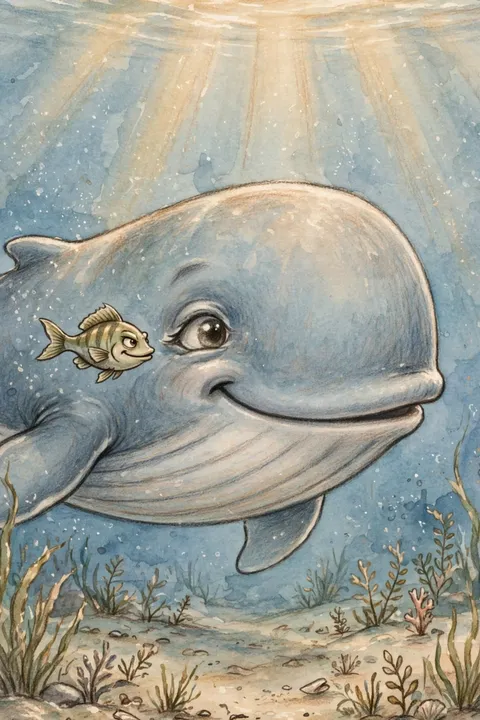
Having eaten nearly every fish in the sea, a Whale is hungry again. A small, astute fish near his ear suggests he try a man, and tells him where to find a shipwrecked sailor on a raft in the middle of the ocean. It is a meal the Whale will not forget.
In English, German, Spanish, French and Italian · about 1,000 words · 5–10 min to read.
Read it
Lees en alemán, a la izquierda. A la derecha tienes el inglés para ayudarte; mientras lees, el botón del ojo lo difumina o lo oculta.
Cada párrafo seguido de su versión en inglés, para tu lector electrónico o tablet, o un PDF en paralelo para imprimir. ¿Qué archivo necesito?
El PDF no necesita cuenta; los archivos para lector electrónico sí, pero es gratuita. Sin pagos y sin instalar nada.
¿Ya tienes una cuenta? Iniciar sesión
Cómo empieza
Es war einmal im Meer, mein allerliebstes Kind, da gab es einen Wal, und der fraß Fische.
In the sea, once upon a time, O my Best Beloved, there was a Whale, and he ate fishes.
Er fraß den Seestern und den Hornhecht, die Krabbe und die Flunder, die Scholle und den Hasel, den Rochen und sein Weibchen, die Makrele und den Hecht, und den wahrhaftig windungsreichen Aal.
He ate the starfish and the garfish, and the crab and the dab, and the plaice and the dace, and the skate and his mate, and the mackereel and the pickereel, and the really truly twirly-whirly eel.
Alle Fische, die er im ganzen Meer finden konnte, fraß er mit seinem Maul – so! Bis schließlich nur noch ein einziger kleiner Fisch im ganzen Meer übrig war, und das war ein kleiner „Schlau-Fisch“, der ein Stück hinter dem rechten Ohr des Wals schwamm, um aus der Gefahrenzone zu bleiben.
All the fishes he could find in all the sea he ate with his mouth—so! Till at last there was only one small fish left in all the sea, and he was a small ‘Stute Fish, and he swam a little behind the Whale’s right ear, so as to be out of harm’s way.
Languages
- How the Whale Got His Throat · English (original)1,042 words · ~5 min
- Wie der Wal zu seinem Schlund kam · GermanB1 Intermediate · 1,024 words · ~10 min
- Cómo le salió la garganta a la Ballena · SpanishB1 Intermediate · 1,043 words · ~10 min
- Comment la baleine eut sa gorge · FrenchB1 Intermediate · 1,118 words · ~10 min
- Come la Balena si procurò la gola · ItalianB1 Intermediate · 988 words · ~10 min
Open in the reader: German with English · Spanish with English · French with English · Italian with English
More stories at this level
Intermediate stories in German with English beside it (all of them: Intermediate German stories).
- Der Wolf und die sieben jungen GeißleinBrothers Grimm · B1 · 1,001 words
- Die wunderbare WeberinJames Baldwin (1841–1925) · B1 · 1,055 words
- Die Geschichte von Benjamin KaninchenBeatrix Potter · B1 · 1,070 words
- Die Geschichte einer StundeKate Chopin · B2 · 974 words
- RumpelstilzchenBrothers Grimm · B1 · 1,080 words
- Wie das Kamel zu seinem Höcker kamRudyard Kipling · B1 · 1,082 words
Reading it as a parallel text
A parallel text puts a story next to its translation, paragraph by paragraph. Read in the language you are working on and glance across only when a sentence stops you: the story keeps moving, and the words you look up stay in context. More in how to read with a parallel text.
Questions
- Which languages can I read How the Whale Got His Throat in?
- English, German, Spanish, French and Italian. Pick the language you want to read and the one to keep beside it: every paragraph sits next to its translation, so you can check a sentence without losing your place.
- What level is it?
- In translation, German, Spanish, French and Italian are B1 Intermediate. Levels follow the Common European Framework, from A1 (beginner) to C2.
- How long is it?
- About 1,042 words: around 5–10 min of reading, with the translation beside it. The time depends on the edition's level: an easier edition is read more slowly.
- Is it free?
- Yes. Read it online with no account. The e-reader files (EPUB, and AZW3 and MOBI for Kindle) need a free account; the PDF doesn't.
- Can I read it on a Kindle or Kobo?
- Yes. Download the EPUB for Kobo, Apple Books and most e-readers, or the AZW3 or MOBI for a Kindle, with each paragraph followed by its translation. There is also a side-by-side PDF to print, and each language on its own.